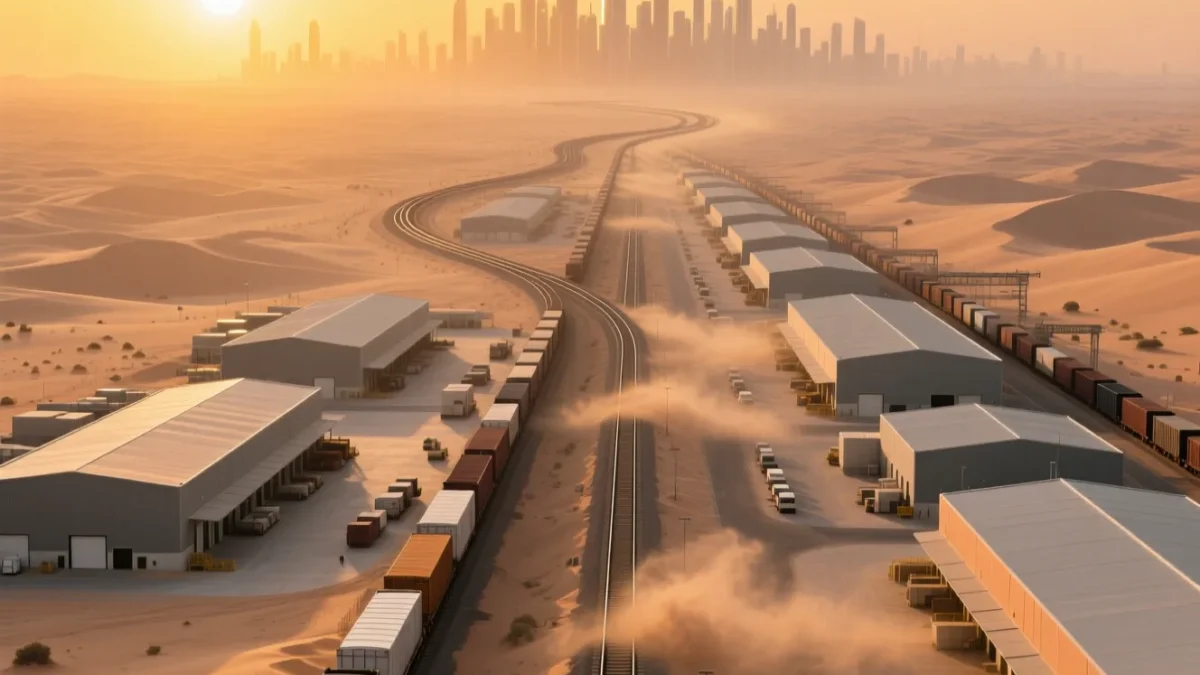
Along Jebel Ali’s container berths, proximity to the quay set the price of a warehouse for two decades, because every box that arrived left again by road, and every kilometre of that road journey was a cost. That logic is now being edited by a railway. With Etihad Rail’s freight network operational and a dedicated terminal opened inside Jebel Ali Port in October 2025, according to Arabian Gulf Business Insight (AGBI), the question a logistics occupier asks is shifting from “how close is this site to the port gate” to “how close is it to the rail-served network.” The answer is repricing land that the port-fence premium had, until recently, treated as second-tier — and Dubai South sits at the centre of that shift.
The corridor that went operational without a ribbon
The United Arab Emirates spent much of the last decade building a national freight railway that, for most of the property market, remained an abstraction on a map. That abstraction is now infrastructure. Etihad Rail’s freight network has been fully operational since the beginning of 2023, running a fleet of 38 locomotives and more than 1,000 wagons across the Emirates, according to Railway Technology. The line connects the country’s principal industrial and port anchors — Jebel Ali and Khalifa Port, the KIZAD industrial zone, and Fujairah on the Gulf of Oman coast — to the manufacturing and distribution clusters inland.
The stated ambition is not modest. Etihad Rail has set a target of moving up to 60 million tonnes of freight a year by 2030, per Railway Technology. For a real estate market that has learned to read port throughput and warehouse absorption, that figure represents a third demand variable that did not exist in the previous cycle: rail-borne cargo that has to be received, sorted, stored and dispatched somewhere. Somewhere means industrial real estate, and the sites that can plug directly into the rail corridor are the ones best positioned to capture that flow. The network did not arrive with the fanfare of a new mall or a record tower; it arrived as a change in the underlying grid on which industrial value is calculated.
What a rail terminal inside Jebel Ali actually changes
The most consequential single event for logistics property in this cycle was not a rent movement but a connection. In October 2025 Etihad Rail opened a freight terminal at Jebel Ali Port, integrating directly with DP World’s operations, with an initial handling capacity of around 600,000 twenty-foot equivalent units (TEU), according to AGBI. That number should be read in proportion. Jebel Ali handled roughly 15.6 million TEU in 2025, against a designed annual capacity of about 19.4 million TEU, per figures attributed to DP World and Lloyd’s List — so an initial rail capacity of 600,000 TEU is a first tranche, not a wholesale replacement of the road drayage that still moves the overwhelming majority of the port’s boxes.
The significance is directional rather than immediate. A container that lands at Jebel Ali and leaves by rail no longer needs to be trucked, individually, to an inland distribution centre. It can move in bulk down the corridor to an intermodal point and be broken down there. The effect on real estate is to stretch the port’s economically viable catchment. A warehouse that was previously “too far” from the quay to compete on landed cost — because road haulage ate the saving — becomes viable if it sits near a rail-served node. In other words, the terminal does not just add capacity at the port; it quietly extends the map of addresses that can credibly call themselves port-adjacent for logistics purposes. That extension is where Dubai South enters the analysis.
Dubai South as the next logistics node
Dubai South has spent this cycle behaving less like a peripheral development zone and more like a supply-constrained prime market. Vacancy in its warehouse stock has run below 3%, with demand dominated by e-commerce and urban-logistics operators, according to industrial market commentary attributed to Knight Frank and sector sources. A sub-3% vacancy rate is not the profile of an emerging district hoping to fill space; it is the profile of a location where occupiers already compete for what exists. The demand driver is structural: the UAE’s e-commerce market was projected to exceed USD 17 billion in 2025 on industry estimates, and every incremental point of online retail penetration converts, eventually, into a requirement for fulfilment space positioned to serve population centres quickly.
What makes Dubai South strategically distinct from the older JAFZA and Jebel Ali industrial belt is its position in the emerging network rather than its distance from the water. It sits within the logistics geography that the rail corridor and the Al Maktoum International Airport expansion are jointly reshaping, giving it a claim to multimodal connectivity — sea, air and, increasingly, rail — that a warehouse defined solely by its walking distance to a container berth cannot make. For an occupier building a national or regional distribution footprint, that multimodal claim is worth paying for, and the low vacancy is the market’s way of confirming it. The reading here is that Dubai South is not competing with Jebel Ali on the old metric of quay-proximity; it is competing on a new metric of network position, and on that metric it is winning share of demand.
How rail integration reprices location value
The deeper point for anyone valuing industrial real estate is that connectivity is being redefined, and with it the geography of premium. In the road-only model, warehouse value decayed fairly smoothly with distance from the port gate: the further out, the higher the trucking cost baked into every pallet, the lower the rent a site could command. Rail breaks that smooth decay. A site with direct or short-haul access to a rail-served terminal captures a cost advantage that a physically closer but rail-isolated site does not. Value stops being a simple function of kilometres to the quay and becomes a function of position on the network.
This has three practical consequences for how the market should be read. First, the premium attached to the oldest port-fence locations is no longer automatic; some of it is transferable to well-connected inland nodes. Second, land that developers and investors might have discounted for its distance from Jebel Ali can be re-rated upward if it plugs into the corridor — which changes the calculus on where new logistics parks make sense to build. Third, the intangible value of a lease is increasingly bound up in the tenant’s ability to reach the whole national grid — Khalifa Port, KIZAD, Fujairah — from a single address, rather than being captive to one port’s road network. Prime logistics yields in Dubai have been quoted in the region of 7.5–8% on leasehold assets, according to commentary attributed to Knight Frank (Destination Dubai 2025); the assets most likely to defend the tighter end of that range in the next phase are those whose location advantage is anchored in network connectivity, not in a proximity premium that rail is steadily eroding.
None of this is a forecast of Jebel Ali’s decline. The port remains the gravitational centre of the system, and DP World reported record revenue of USD 24.4 billion and EBITDA of USD 6.4 billion for 2025 on the strength of that centrality. The argument is narrower and more useful: the value that Jebel Ali generates is beginning to distribute itself along the rail corridor rather than pooling entirely at the fence line, and industrial real estate strategy has to follow the distribution.
The decarbonisation dimension occupiers now price in
There is a second variable that the previous logistics cycle did not seriously price, and it is arriving alongside the rail network rather than by coincidence. Rail freight carries a materially lower carbon cost than road haulage: Etihad Rail’s network is projected to cut transport-related CO2 emissions by up to 80% compared with equivalent road transport, with an expected annual reduction in the order of 8.2 million tonnes of CO2, according to Sustainability Magazine citing Etihad Rail. For a distribution operator whose customers — particularly multinational retailers and manufacturers — increasingly report on supply-chain emissions, the ability to route freight by rail is no longer only a cost question. It is a compliance and reputational asset.
That reframes what a “rail-connected” warehouse offers a tenant. It is not merely cheaper trucking avoided; it is a measurable reduction in the emissions footprint of the tenant’s logistics operation, documented and reportable. As corporate procurement in the GCC begins to weigh embodied and operational carbon in site selection, a warehouse with credible rail access acquires an ESG dimension that a road-only competitor cannot easily replicate. The expectation is that this decarbonisation attribute will, over the coming cycle, migrate from a soft preference into a hard line item in occupier requirements — and that landlords who can evidence rail connectivity will find it reinforcing exactly the location premium the network is already creating. In a market where prime logistics vacancy already sits below 3% in the strongest nodes, that is a premium with little to dilute it.
Conclusions
The next phase of Dubai’s logistics real estate story is not being written in rent tables; it is being written in the grid those rents are calculated on. Etihad Rail’s network, operational since 2023 with 38 locomotives and more than 1,000 wagons and targeting up to 60 million tonnes of freight a year by 2030, together with the freight terminal opened at Jebel Ali Port in October 2025 at an initial 600,000 TEU, is redefining what “well-located” means for an industrial asset. Proximity to the quay is being supplemented — and in places supplanted — by position on the network, and Dubai South, with vacancy below 3% and demand led by e-commerce and urban logistics, is the clearest beneficiary of that shift. Layered on top is a decarbonisation advantage of up to 80% lower transport emissions that occupiers are starting to price directly. For investors and developers, the discipline for the next cycle is to stop valuing warehouses by their distance to the port and start valuing them by their access to the rail-served network — because that is the metric the market is already moving to.
This article is for general information only and does not constitute legal, tax or financial advice.