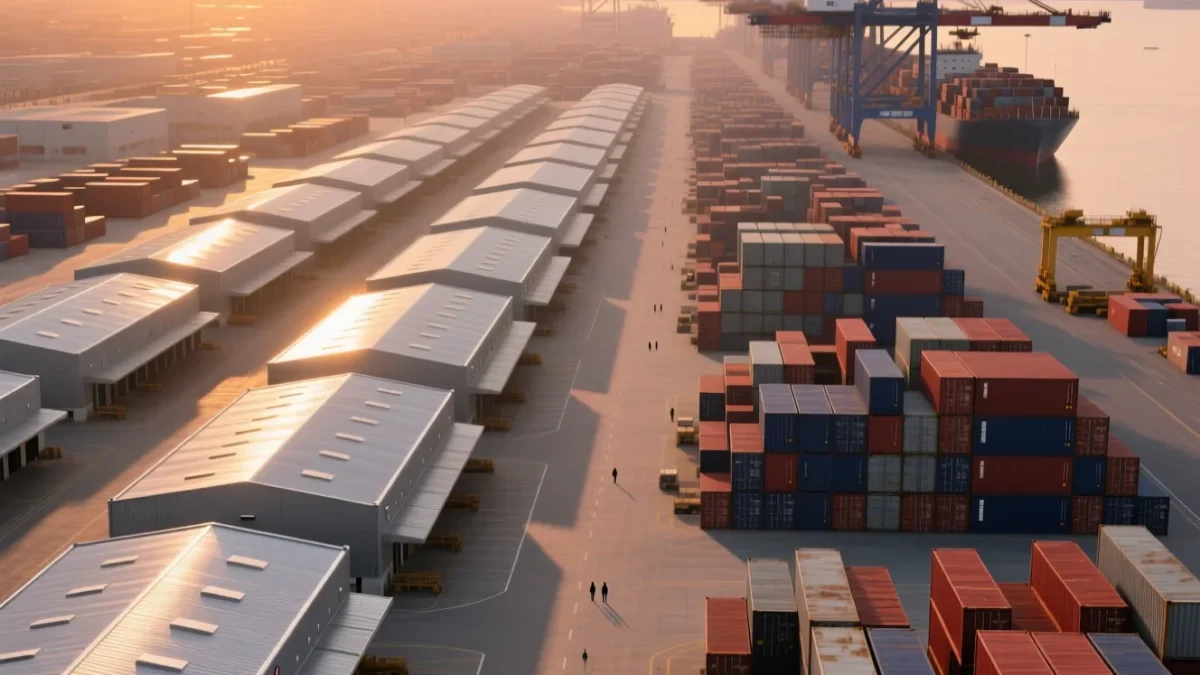
Grade-A warehouse rents around Jebel Ali climbed by roughly 22% in a single year, the tightest squeeze in Dubai’s 2025–2026 property market. While headlines track record port volumes and glass towers, the tightest segment of the emirate’s property market in 2025 and into 2026 has been the industrial one: Grade-A warehouse space around Jebel Ali Free Zone (JAFZA) and Dubai South, where rents climbed by roughly a fifth to a quarter in a single year and prime vacancy fell below the level at which tenants can realistically shop around. According to Knight Frank’s UAE Industrial & Logistics Report for H2 2025, Grade-A warehouse rents in JAFZA North and South reached about AED 40–45 per sq ft, up by close to 22% year on year, while Dubai South rents ran higher still, at roughly AED 45–55 per sq ft after an increase of about 25%. Those are not the numbers of a market with slack in it.
A record throughput year that the property market cannot fully house
The gravitational centre of this market is Jebel Ali Port, the largest container hub between Rotterdam and Singapore and the anchor around which the whole free-zone logistics ecosystem is organised. Its operator, DP World, reported record revenue of USD 24.4 billion and EBITDA of USD 6.4 billion for 2025, figures the company published in its 2025 results announcement in March 2026. Jebel Ali handled 15.6 million twenty-foot equivalent units (TEU) over the course of 2025, with the first half alone processing 7.7 million TEU, up about 6% year on year, according to the same DP World disclosures.
To read those volumes correctly, they need to be set against the port’s physical ceiling. Jebel Ali’s designed annual handling capacity is approximately 19.4 million TEU; against 2024’s throughput of 15.536 million TEU — its highest since 2015, per DP World and Lloyd’s List data — the terminal was already running at close to 80% utilisation. A port operating that far up its capacity curve does not merely move more boxes; it generates a rising, and increasingly inelastic, demand for the land-side infrastructure that receives, stores, sorts and redistributes those boxes. Every additional container that crosses the quay eventually needs a shelf. And it is on the shelf side — the warehouse — that Dubai’s supply has struggled to keep pace.
The rent numbers: a supply crunch, not a demand blip
What distinguishes 2025–2026 from an ordinary cyclical upswing is that the rent increases are broad, sustained and concentrated in the best-quality stock. The Knight Frank H2 2025 report puts Grade-A JAFZA rents at roughly AED 40–45 per sq ft after a rise of about 22% over the year, and Dubai South at AED 45–55 per sq ft after about 25%. A separate reading from Cushman & Wakefield, reported via Zawya, placed the average Dubai warehouse rate at around AED 46 per sq ft in Q2 2025, up roughly 19.9% year on year — a slightly different figure drawn on a different basket of stock, but pointing unmistakably in the same direction. The consistency across independent brokerages matters: when JLL-adjacent, Cushman and Knight Frank readings all land inside a AED 40–55 band with double-digit annual growth, the signal is structural rather than the artefact of one consultancy’s methodology.
The clearest confirmation that this is a supply story rather than a demand bubble is vacancy. Prime industrial vacancy across Dubai’s core logistics zones has been running below 5%, and in Dubai South specifically below 3%, according to Knight Frank and industry commentary from late 2025 into 2026. At those levels the market has effectively no float: a tenant whose lease expires cannot count on an alternative Grade-A unit being available at all, let alone at a lower rent, which hands landlords the pricing power that the rent trajectory reflects. In several Dubai submarkets, prime logistics rents rose by more than 15% over 2025 on Knight Frank’s reading, driven by third-party logistics (3PL) operators, e-commerce fulfilment and regional distributors competing for the same limited pool of high-specification space.
Why the demand will not simply cool off
Warehouse demand of this intensity is not a speculative overhang that a single soft quarter will clear, because the forces behind it are structural changes in how goods reach the end consumer. The most cited driver is e-commerce: the UAE’s online retail market was projected to exceed USD 17 billion in 2025 on industry estimates, and every incremental point of e-commerce penetration converts into disproportionate demand for warehousing, because fulfilling individual online orders is far more space- and labour-intensive per unit of sales than replenishing a shop shelf. Order picking, returns processing, last-mile staging and buffer stock all need floor area that traditional wholesale distribution never required.
Layered on top is the 3PL sector — the specialist operators to whom manufacturers and retailers outsource storage and distribution. As regional and multinational brands consolidate their Gulf, wider GCC and East Africa supply chains through Dubai, they increasingly lease through 3PL providers rather than building their own sheds, which concentrates demand into the exact Grade-A, well-located, high-eaves, temperature-capable stock that is scarcest. The result is a market where the type of space in shortest supply is precisely the type in greatest demand — the defining condition of a genuine crunch, as opposed to a general shortage that cheaper or lower-grade space could relieve.
It is worth being precise about geography here, because it drives value. JAFZA offers the free-zone regime — 100% foreign ownership, customs advantages, direct port adjacency — that suits re-export and trading businesses moving goods through rather than into the UAE. Dubai South, built around Al Maktoum International Airport and the emirate’s future aviation and logistics corridor, has emerged as the higher-rent pole, which is itself telling: tenants are paying a premium there not for port adjacency but for a modern, purpose-built urban-logistics and air-cargo-linked footprint. The AED 45–55 per sq ft that Dubai South commands, against JAFZA’s AED 40–45 on the Knight Frank H2 2025 figures, is a market pricing the future weight of air freight and last-mile distribution into today’s rent.
What the crunch means for investors and yields
For capital, a market with sub-5% vacancy and double-digit rental growth is an unusually clean investment case, and the yield evidence reflects that. Prime logistics assets in Dubai have been trading at yields of roughly 7.5–8%, on leasehold onshore and offshore stock, according to Knight Frank commentary (Destination Dubai 2025). Set against the compressed yields available on prime offices or prime residential, industrial offers both a higher running return and rental growth momentum underpinned by the supply shortage — a combination that has drawn institutional capital that historically overlooked the sector as unglamorous.
The analytical caution here is the same one that applies to any market running this hot: rents rising 20–25% in a year are, by definition, coming off a supply-demand imbalance that development will eventually attempt to correct. New Grade-A stock is being built, and speculative development responds to exactly these signals. The question for a warehouse investor is not whether Dubai’s logistics rents are high — they demonstrably are — but how much of the current growth rate is durable structural demand from e-commerce and 3PL consolidation, and how much is a temporary premium that new supply will erode over the next two to three years. On the evidence of 2025, the structural share looks large: the port is running near capacity, e-commerce penetration is still climbing, and the highest rents are being paid for the modern, well-located stock that takes the longest to build. But an investor underwriting today’s AED 50-plus per sq ft as a permanent floor rather than a cyclical peak is taking a view, not reading a certainty.
Rail integration and the next leg of location value
One development is worth flagging because it reshapes the map of where warehouse value will accrue next: the arrival of rail. Etihad Rail opened a freight terminal at Jebel Ali Port in October 2025, integrated with DP World operations and with an initial handling capacity of around 600,000 TEU, according to AGBI. The national freight network, fully operational since early 2023, links Jebel Ali with Khalifa Port, KIZAD, Fujairah and the industrial zones of the northern emirates. For logistics real estate the significance is locational: a warehouse with efficient rail access to the port and to inland industrial clusters carries a different value profile from one dependent solely on road haulage, and as the network matures, proximity to rail terminals is likely to become a pricing factor in its own right. The supply crunch of 2025–2026 is, in that sense, the opening chapter of a longer repricing of industrial land around the multimodal nodes that Dubai is deliberately building out.
Conclusions
Dubai’s logistics property market entered 2026 as the tightest segment of the emirate’s real estate, and the data explains why. Grade-A warehouse rents reached roughly AED 40–45 per sq ft in JAFZA and AED 45–55 per sq ft in Dubai South on Knight Frank’s H2 2025 figures, up about 22% and 25% respectively, while prime vacancy fell below 5% — under 3% in Dubai South. Behind those numbers sits a port running near its 19.4 million TEU capacity ceiling after handling 15.6 million TEU in 2025, and a demand base — e-commerce past USD 17 billion, plus 3PL and regional distribution consolidation — whose appetite for high-specification space structurally outruns the pace at which such space can be built. For occupiers, the practical reality is negligible negotiating leverage and the need to secure and renew space earlier than a looser market would require. For investors, prime logistics yields of about 7.5–8% offer a rare combination of running return and rental momentum, tempered by the standard caution that no market grows rents at a quarter a year indefinitely. The scarcest real estate in Dubai remains, for now, the shed near the quay — and the arrival of rail is already redrawing where the next shortage will form.
This article is for general information only and does not constitute legal, tax or financial advice.