Across Dubai’s retail map, a neighbourhood centre in Nad Al Sheba and The Dubai Mall compete for almost nothing. They appear in the same market reports, under the same word — retail — and are frequently discussed as if they rise and fall together. They do not. Dubai’s retail property market is not one market moving at one speed; it is at least two, running on opposite business models, filled by different tenants, serving different catchments and carrying different risk. One is a convenience machine that fills up within a year of opening because people who live nearby need it every week. The other is a global destination that depends on 19.59 million overnight tourists and a luxury economy for its economics to work. Reading them as a single asset class is the most common mistake made about Dubai retail — and the segmentation, not the headline occupancy figure, is where the real story sits.
One label, two catchment logics
The starting point for understanding the split is catchment — who a centre is built to serve and how far they travel to reach it. A super-regional or “prime destination” mall is designed to pull from the entire emirate and well beyond it. The Dubai Mall drew roughly 111 million visitors in 2024, up from 105 million in 2023, according to figures attributed to Emaar chairman Mohamed Alabbar and reported by Time Out Dubai in January 2025 — a number larger than the population of most countries and one that only makes sense when the catchment is the world, not the district. Its roughly 350,000 sq m of retail area and more than 1,200 units, as documented by Cushman & Wakefield Core in 2025, are underwritten by tourism and discretionary luxury spending, not by the weekly needs of the people who live in the towers next door.
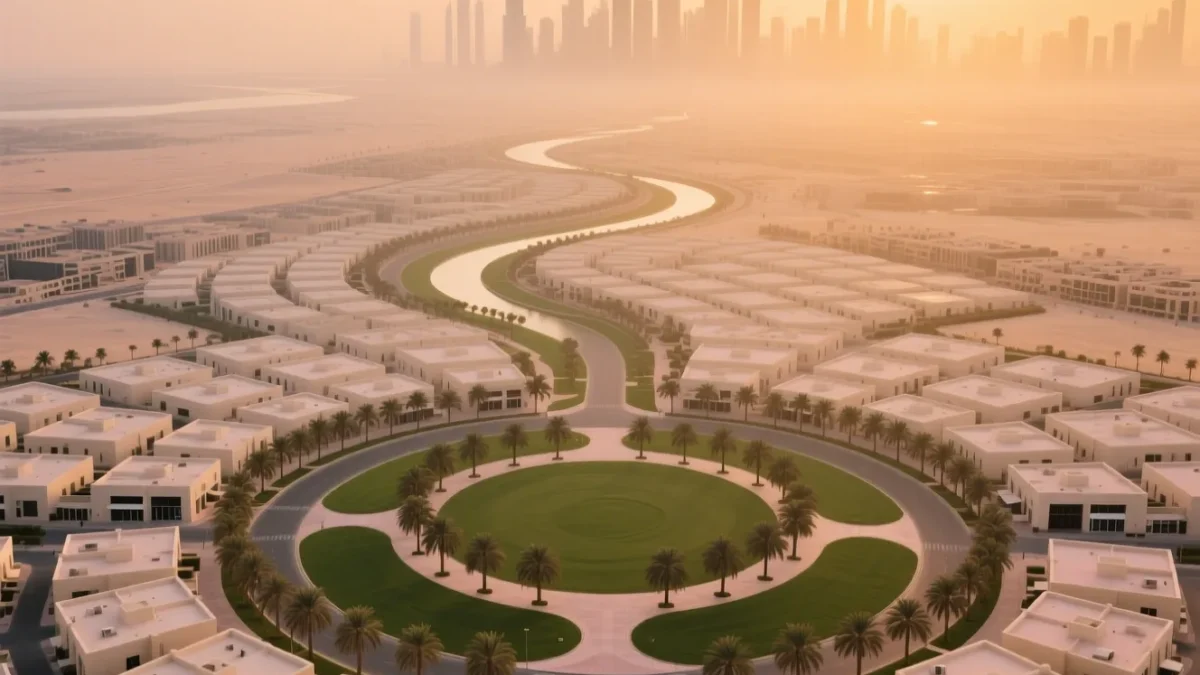
A community mall inverts every one of those assumptions. Its catchment is a fifteen-minute drive at most, often a walk. It is not trying to be a reason to travel across Dubai; it is trying to be the most convenient option for the households immediately around it. That single design decision cascades into everything else — the tenant mix, the lease terms, the speed at which the centre fills, and the kind of risk its owner is carrying. The two formats are not points on a spectrum of the same product; they are different products that happen to share a regulatory category.
The tenant mix is the business model
Nowhere is the divergence clearer than in who signs the leases. According to Cushman & Wakefield Core’s Dubai annual retail market update for 2025/2026, community centres in areas such as Al Barsha, Motor City and Nad Al Sheba are anchored by a recognisable and repeatable combination: a supermarket, a clinic, a fitness operator and home-grown F&B. That mix is not accidental and it is not aspirational — it is a needs-based portfolio. A supermarket generates the weekly footfall that everything else feeds on; a clinic brings recurring, appointment-driven visits; a gym creates habitual daily traffic; and local F&B converts all of it into dwell time and repeat spending. The logic is convenience and frequency, and every anchor is chosen because residents cannot easily do without it.
Super-regional centres are built on the opposite tenant logic. Their anchors are luxury, F&B and entertainment, as the same Cushman & Wakefield Core update sets out — a mix engineered for aspiration, discovery and long dwell time rather than weekly necessity. This is where global fashion houses want a flagship, where a meal is an occasion rather than a convenience, and where entertainment is a destination anchor in its own right. The tenant that pays to be in The Dubai Mall is buying a global stage and a tourist audience; the tenant that signs in a Nad Al Sheba centre is buying a captive, recurring residential customer. Neither would function in the other’s building, and that is the clearest evidence that these are two businesses, not one.
Why community malls fill up faster than anyone expects
The most striking operational contrast is lease-up speed — how long a centre takes to reach stable occupancy after opening. Cushman & Wakefield Core’s 2025/2026 update records that community malls in Al Barsha, Motor City and Nad Al Sheba are reaching full occupancy within a year of completion. For a physical asset of that size, a twelve-month path to stabilisation is fast, and it is a direct product of the business model. Demand for a convenience centre pre-exists the building: the residents are already there, already spending on groceries, healthcare and fitness somewhere, and a well-located centre simply captures spending that was leaking to less convenient options. There is little demand to create, only demand to capture.
Super-regional lease-up is a slower, more curatorial process, because a destination mall is not capturing existing demand so much as manufacturing a reason to travel. Occupancy at Dubai’s prime destination malls sits at roughly 95–99%, in places reaching 98%, and the market remains, in Cushman & Wakefield Core’s words, a landlord’s market. But that high occupancy is the end state of a longer courtship — of aligning international brands, negotiating flagship formats and sequencing anchors so the whole is worth more than its units. Community demand shows up; destination demand has to be assembled. The occupancy numbers can look similar at maturity, but the road to them, and the effort required to hold them, is not.
Rents, renewals and the pressure of scarce prime space
The scarcity dynamics also differ, and they show up in the rent data. Across the top of the market, prime retail rents rose in 2025 — Cushman & Wakefield’s 2025/2026 read puts prime rental growth at roughly 9% year on year, while analysis cited by Cavendish Maxwell for 2025 records prime rents up about 7.1% year on year alongside a telling split: new lease agreements down 15.7% while renewals rose 6.5%. That combination is the signature of a supply-constrained prime segment. When new leasing volume falls but renewal values rise, it usually means tenants already inside the best space are holding on and paying more to stay, because there is nowhere better to go. Dubai’s short-term retail pipeline is only about 250,000 sq m of GLA in total across 2025–2026, against a standing stock of roughly 4.89 million sq m, on JLL’s Q3 2025 figures — a thin addition to supply that keeps the pressure on the prime end.
Community retail experiences scarcity differently. Its constraint is not a shortage of trophy space but the pace of residential development: a new community centre becomes viable when a neighbourhood reaches critical mass, and its rent is disciplined by what nearby households can sustainably spend on convenience, not by what a global brand will pay for a flagship address. The result is rent that is lower in absolute terms but structurally steadier, tracking population and household formation rather than tourism cycles and luxury sentiment. Two different scarcities, two different rent curves.
Two risk-and-return profiles, not one
Put the pieces together and the investment character of each segment falls out cleanly. Community retail is the defensive position. Its revenue rests on non-discretionary spending — groceries, healthcare, fitness — that residents sustain through good years and bad, insulating it from the tourism and luxury swings that move the top of the market. Its lease-up is fast, its catchment is captive, and its rents track a growing resident base: Dubai’s population passed four million for the first time in 2025, roughly 92% of it expatriate, on Dubai Statistics Center figures. Every new populated district is, in effect, demand waiting for a convenience centre. The trade-off is a ceiling: convenience rents do not spike, and a community centre will never command the headline figures of a flagship atrium.
Super-prime is the higher-beta position — larger revenue potential, higher rents, but tied to variables the landlord does not control. Its economics lean on 19.59 million overnight visitors in 2025, up 5% on the year and reported by Dubai’s Department of Economy and Tourism on 9 February 2026, and on a UAE luxury-goods market that Mordor Intelligence sized at around USD 8.5 billion in 2025. Those are powerful tailwinds today, and they are also the exposure: a destination mall’s performance is levered to tourism arrivals, luxury sentiment and global discretionary spending in a way a supermarket-anchored neighbourhood centre simply is not. Higher potential return, higher sensitivity to cycles the owner cannot steer — that is the trade, and it is the opposite trade from community retail.
What the split means for developers and investors
For anyone allocating capital to Dubai retail, the practical consequence is that the two segments call for different underwriting entirely. A community centre should be underwritten on catchment demographics, household density and the durability of needs-based demand — a fast, defensive, cash-generative asset whose main question is whether the surrounding population justifies the gross leasable area. A super-regional asset should be underwritten on destination pull, tenant curation and exposure to tourism and luxury cycles — a slower, more capital-intensive proposition whose value is made or lost in the quality of its anchors and the strength of the visitor economy. Applying one lens to the other is how mistakes are made in both directions: over-paying for a community centre as if it carried destination upside, or dismissing a flagship’s cyclicality because the current occupancy looks bulletproof.
The reason both models can thrive simultaneously is that Dubai’s demand is genuinely two-sided. The resident base is growing and spreading into new districts, feeding the community pipeline; the visitor economy set successive records, with December 2025 the first single calendar month to exceed two million tourists on DET figures, feeding the destination end. The mistake is to let the visibility of the flagships — and the capital being poured into them — stand in for the health of the whole sector. The quieter economics of a supermarket-anchored centre reaching full occupancy in twelve months tell a different, and in many ways more resilient, story about where steady retail returns in Dubai are actually made.
Conclusions
Dubai retail is best read as a two-speed market. At one end, community malls in districts such as Al Barsha, Motor City and Nad Al Sheba fill within a year of opening, anchored by supermarkets, clinics, fitness and home-grown F&B, running on captive resident demand and non-discretionary spending — steady, defensive, capacity-limited by population rather than by scarcity of trophy space. At the other, super-regional destinations run at 95–99% occupancy in a landlord’s market, anchored by luxury, F&B and entertainment, with prime rents up around 7–9% year on year and renewals outpacing new leases as prime space stays scarce — higher-return but levered to 19.59 million tourists and an USD 8.5 billion luxury economy the landlord cannot control. The headline occupancy figures can look alike; the business models behind them do not. For investors and developers, the segmentation is the analysis: the two ends of Dubai retail reward different capital, carry different risk, and should never be underwritten as the same asset.
This article is for general information only and does not constitute legal, tax or financial advice.