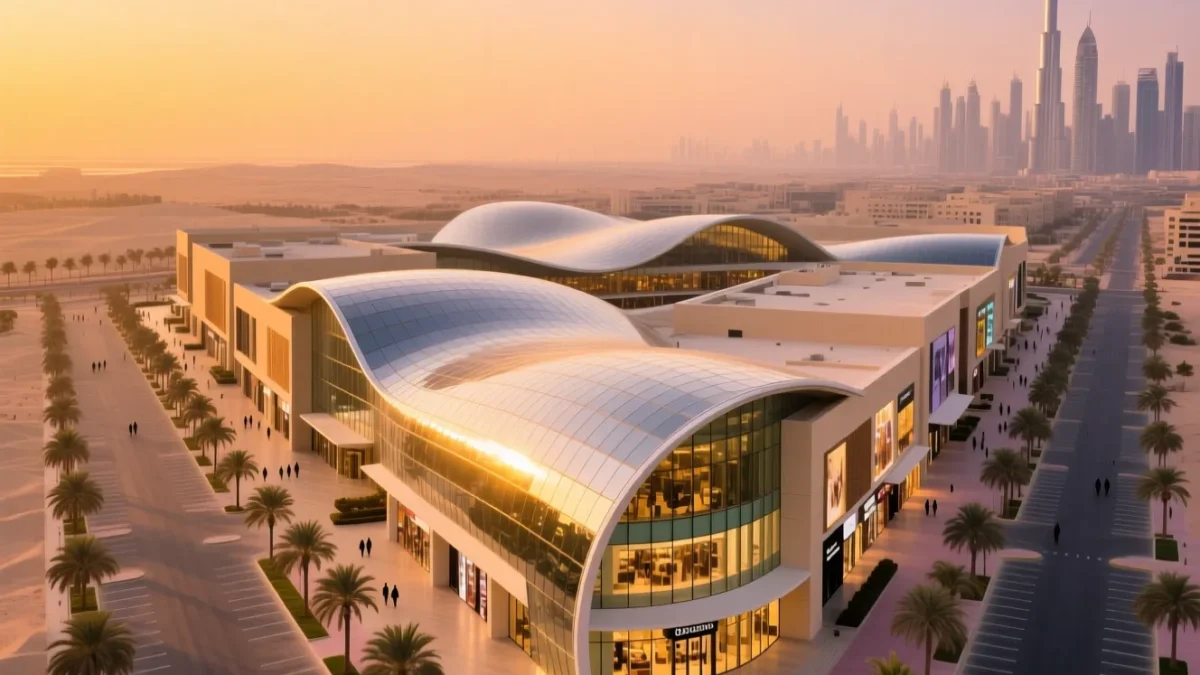
A full mall is not the same as a market that is growing for the tenant. Dubai’s leading shopping centres in 2026 present a picture of unmistakable strength: crowded atria, flagship boutiques trading at capacity, and waiting lists for the best units. That picture is real, but it is easy to misread. The same conditions that make the malls look buoyant to a visitor make them punishing to a retailer trying to secure prime space. What has actually happened in Dubai’s retail property market is not a broad expansion in which everyone wins, but a sharp tilt in bargaining power toward landlords — driven far more by a scarcity of prime floorspace than by a surge in new demand. Reading the difference between those two explanations is the key to understanding where retail rents, occupancy and tenant strategy are heading this year.
Why occupancy has stopped being a reliable signal
Across most retail markets, high occupancy is read as a proxy for health: full malls mean confident retailers, and confident retailers mean rising sales. In Dubai in 2026, that shorthand has broken down, because occupancy has climbed so high that it no longer reflects the balance between supply and demand — it reflects the absence of available space. According to Cushman & Wakefield Core’s Dubai Annual Retail Market Update 2025/2026, occupancy in the emirate’s super-regional and prime destination malls sits at roughly 95 to 99 per cent, with some assets at around 98 per cent, and the consultancy is explicit that the market “remains a landlord’s market.” When a market is that full, the headline occupancy figure stops measuring retailer appetite and starts measuring how little room is left to absorb it.
The distinction matters because the two interpretations point to opposite strategies. If near-full malls signalled booming demand, the rational response would be to build more space and ride the wave. If, instead, they signal that supply has failed to keep pace, the operative variable becomes scarcity — and scarcity is what allows landlords to dictate terms. The Dubai evidence in 2026 points firmly to the second reading, and the supply figures explain why.
A prime pipeline that cannot keep pace with the city
Dubai’s total retail stock stands at roughly 4.89 million square metres of gross leasable area (GLA), a figure that has been broadly stable, according to JLL’s UAE Retail Market Dynamics data as of Q3 2025. Against that base, the short-term pipeline is strikingly thin: JLL puts the near-term retail supply due across 2025 and 2026 combined at around 250,000 square metres of GLA. In relative terms, that is close to five per cent of the existing stock spread over two years — modest for a city whose population crossed four million for the first time in September 2025, per figures attributed to the Dubai Statistics Center, and whose international overnight visitor count reached 19.59 million in 2025, up five per cent year on year, according to the Dubai Department of Economy and Tourism, reported by the Dubai Media Office on 9 February 2026.
The mismatch is not simply that supply is small in aggregate; it is that the supply which does exist is not evenly useful. Much of Dubai’s new retail delivery is community-scale, tied to residential districts, while the prime and super-regional space that international brands and luxury houses actually compete for is barely expanding. Even the marquee additions are extensions of existing assets rather than new destinations: Emaar’s “The District” expansion at The Dubai Mall, an AED 1.5 billion project adding around 240 luxury retail and dining options, deepens an already dominant asset rather than creating an alternative to it. The effect is to concentrate demand onto a fixed set of trophy locations, which is precisely the condition under which landlords gain pricing power.
What the leasing data actually says
The clearest evidence that Dubai retail has become a landlord’s market lies not in occupancy but in the direction of leasing activity, and here the numbers cut against the intuition that a strong market means more deals. Data cited from Cushman & Wakefield and Cavendish Maxwell for 2025 shows new lease agreements down 15.7 per cent, while lease renewals rose 6.5 per cent and rental rates increased 7.1 per cent year on year. Read together, those three figures describe a specific market state: retailers are renewing where they already sit rather than moving, new leasing has slowed because there is little prime space to move into, and rents are rising anyway because the scarcity gives landlords the upper hand at the renewal table.
This is the opposite of a demand-led boom, in which new leases would be climbing as retailers expanded into fresh space. A fall in new leases combined with rising renewals and rising rents is the signature of a supply-constrained market. Sitting tenants stay put because the alternative — finding comparable prime space elsewhere — barely exists, and that captivity is exactly what lets landlords push renewal rents higher. A separate reading attributed to Cavendish Maxwell and Cushman & Wakefield puts prime retail rental growth as high as around nine per cent year on year for 2025, though that figure comes through secondary aggregation of agency data and is best treated as indicative of direction rather than a precise headline. Whether the true number is closer to the 7.1 per cent renewal-rent figure or the nine per cent prime figure, the vector is the same: up, and set by the landlord.
Where the scarcity concentrates: the super-prime tier
Scarcity in Dubai retail is not spread evenly; it is at its most acute in the super-prime tier, the flagship boutique locations within the very best malls. Industry estimates put super-prime rents for flagship and luxury units in the region of AED 7,500 to 10,500 per square metre per year, with prime high-traffic space — the main atria and premium galleries — in the order of AED 5,500 to 7,500 per square metre per year; these ranges come from agency and secondary sources rather than a single primary report, and should be read as market indications rather than fixed tariffs. The point they illustrate is structural rather than arithmetic: the gap between super-prime and merely prime rents reflects how narrow the pool of genuinely trophy space has become.
Dubai Mall’s Fashion Avenue sits at the apex of that pool. It has been cited among the most expensive retail locations in the world — ranked eleventh globally in aggregated agency commentary drawing on Cushman & Wakefield and Savills data for 2025 — a claim that circulates through secondary sources and is worth flagging as directional rather than definitively sourced. What is not in doubt is the underlying logic: The Dubai Mall carries roughly 350,000 square metres of retail GLA across more than 1,200 units, according to Cushman & Wakefield Core, and it drew about 111 million visitors in 2024, up six per cent on the prior year, per figures attributed to Emaar. A single asset of that footfall and prestige becomes a near-mandatory address for luxury brands, and when the mandatory addresses are few and full, their landlords set the price. The AED 1.5 billion “The District” extension adds luxury and dining capacity precisely because the demand to be inside that asset outstrips the space available to satisfy it.
The demand side: who keeps the prime malls full
Scarcity only translates into pricing power if demand is durable, and Dubai’s demand base is unusually deep. The city’s resident population is roughly 92 per cent expatriate, per Dubai Statistics Center figures cited for 2025, a demographic that skews toward higher discretionary spend and treats the super-regional mall as a default social and retail venue rather than an occasional destination. Layered on top is a tourism engine that set a third consecutive record in 2025: 19.59 million international overnight visitors, hotel occupancy averaging 80.7 per cent, and — for the first time — more than two million visitors in a single calendar month in December 2025, all according to the Dubai Department of Economy and Tourism as reported on 9 February 2026. Roughly 44.85 million occupied room-nights over the year translate into a continuous flow of high-spending visitors for whom the flagship malls are a core part of the Dubai experience.
That demand also has a luxury tilt that maps directly onto the super-prime retail tier. The UAE luxury-goods market was valued at around USD 8.5 billion in 2025, according to Mordor Intelligence, and the emirate accounts for the largest single share of GCC luxury spending. For a luxury house, being absent from Dubai’s prime malls is not a viable position, which is why the competition for a finite set of flagship units is so intense — and why landlords holding those units face so little pressure to compete on rent. The demand is not merely present; it is structurally committed to a small number of addresses.
The two-speed reality behind the headline
The landlord’s-market framing applies most forcefully to the prime and super-prime segments, and it is worth being precise that Dubai retail is running at two speeds. At the community-mall level — the neighbourhood centres in districts such as Al Barsha, Motor City and Nad Al Sheba — Cushman & Wakefield Core notes that new schemes are reaching full occupancy within about a year of opening, anchored by a convenience-led mix of supermarket, clinic, fitness and home-grown F&B. That is a healthy, absorptive market, but it is a different game from the prime tier: community demand is served by a steadier flow of new neighbourhood supply, so the scarcity dynamic is milder and the rent pressure less extreme.
It is the prime and super-regional tier where the squeeze is real, because that is where new supply is genuinely constrained and demand is both deep and concentrated. Conflating the two speeds is how the market gets misread: a developer looking at brisk community-mall lease-up might conclude there is room to build prime space profitably, when the prime constraint is precisely what is generating today’s rents. The AED 5 billion transformation of Mall of the Emirates announced by Majid Al Futtaim on 16 April 2025 — adding some 20,000 square metres of retail space along with cultural and entertainment components — is a bet on deepening an existing prime destination rather than multiplying the number of them, which is consistent with a market where prime scarcity, not raw growth, is the operative force.
Conclusions
Dubai’s prime retail market in 2026 is a landlord’s market, but the reason is easy to get wrong. The full malls, the 95-to-99-per-cent occupancy reported by Cushman & Wakefield Core, and the rising rents do not add up to a story of broad, demand-led growth in which every retailer benefits. They add up to a story of scarcity: a stable stock of roughly 4.89 million square metres of GLA, a thin near-term pipeline of about 250,000 square metres across 2025 and 2026 per JLL, and prime additions that deepen existing trophy assets rather than create new ones. The leasing data confirms it — new leases down 15.7 per cent, renewals up 6.5 per cent and rents up 7.1 per cent year on year, on Cushman & Wakefield and Cavendish Maxwell data for 2025 — describing tenants who renew because they cannot move and landlords who raise rents because they can. For a retailer, the lesson is that a packed mall is a warning, not just an opportunity: prime space in Dubai is priced by its scarcity, and that scarcity is unlikely to ease materially while the pipeline stays this thin. The variable that matters is not how full the malls look, but how little room is left to enter them.