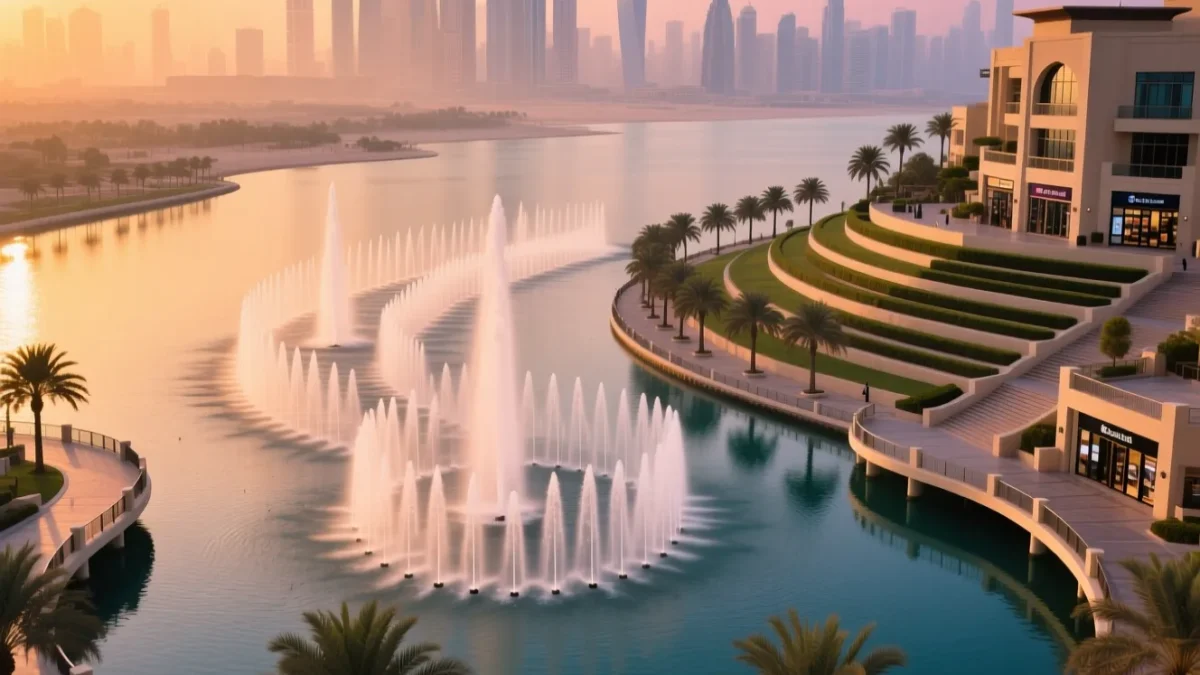
The scarcest thing a Dubai mall now sells is not floor space — it is time. For most of retail history, a shopping centre was a rack of leasable units, and its economic logic was simple: fill the rack, collect the rent. That logic still pays the bills, but it no longer explains where the largest operators in Dubai are putting their capital. In 2026 the headline investments are not additional shops; they are theatres, IMAX screens, wellness clubs, cultural hubs and landscaped dining courtyards. Majid Al Futtaim has committed AED 5 billion to reinvent a single mall, and Emaar is spending AED 1.5 billion to extend another — not primarily to add retail lines, but to lengthen the visit. Understanding that shift, from selling space to selling time on site, is the key to reading Dubai’s retail real estate market this year.
From point of sale to point of experience
The global retail industry has spent the better part of a decade absorbing a single hard truth: the transactional function of the physical store — swap money for a product and leave — is the one function e-commerce performs more cheaply and conveniently. What a website cannot replicate is presence: the meal, the show, the treatment, the branded environment a person chooses to spend an afternoon inside. The strategic response, visible across mature markets, has been to reposition the mall as a lifestyle destination rather than a distribution point, folding food and beverage (F&B), leisure and entertainment into the tenant mix until the shop becomes one reason to visit among several.
Dubai did not invent this playbook, but it is executing it at a scale and speed that few markets can match. The emirate’s retail base is unusually exposed to the two audiences that most reward experiential formats — a resident population that is overwhelmingly international and a tourism inflow near record highs — and its leading landlords have the balance sheets to rebuild ahead of demand rather than in response to it. The result is that the experiential turn in Dubai is not a marketing veneer applied to existing centres; it is being poured into concrete and multi-year capital programmes.
One landlord, forty destinations: the “Dubai Retail” consolidation
The clearest structural signal of the shift is organisational. Dubai Holding Asset Management has consolidated more than 40 malls and lifestyle destinations — including assets absorbed through the integration of Nakheel and Meydan — under a single unified brand, “Dubai Retail”, according to Dubai Holding. The consolidated portfolio spans roughly 6,500 retailers across more than 13 million sq ft of gross leasable area (GLA).
The significance is not the tally of tenants but the deliberate framing. Grouping community centres, super-regional malls and waterfront lifestyle districts under one operating brand tells the market that these assets are now managed as a single portfolio of destinations rather than as a scattered collection of rent rolls. It allows a landlord to think about tenant mix, footfall and experience programming across dozens of sites at once — to move a concept, a food hall format or an entertainment anchor between locations, and to negotiate with brands as one counterparty controlling a very large share of the emirate’s organised retail space. That is the institutional plumbing an experiential strategy needs, and its emergence in Dubai is itself a data point about where the market is heading.
Mall of the Emirates: AED 5 billion to rebuild around the visit
The most explicit statement of the experiential thesis is Majid Al Futtaim’s transformation of Mall of the Emirates. Announced on 16 April 2025 to mark the centre’s twentieth anniversary, the programme carries a headline value of AED 5 billion, with AED 1.1 billion allocated to the first phase, according to Majid Al Futtaim. On the pure retail side it adds about 20,000 sq m of space and more than 100 new stores — but the retail expansion is not the story the operator chose to lead with.
What the announcement foregrounds is a set of non-retail anchors. A cultural hub styled “New Covent Garden” is to house a 600-seat theatre operated in partnership with a Dubai Performing Arts Academy; VOX Cinemas is adding an IMAX offering; a SEVEN Wellness Club brings a fitness and wellbeing anchor into the centre; four new entertainment concepts are slated to open by the end of 2026, followed by an outdoor F&B courtyard in early 2027, according to Majid Al Futtaim. Read together, these components describe a mall being rebuilt around reasons to arrive early, stay longer and return for something other than shopping. A theatre programme brings evening footfall a fashion floor cannot; a wellness club converts a one-off visitor into a recurring member; an outdoor dining courtyard extends the usable hours of the asset into the cooler evening and captures the meal occasion that increasingly precedes or replaces the purchase.
The Dubai Mall’s “District”: luxury and dining as the growth edge
The same instinct is visible at the other end of the market, in the world’s most-visited retail asset. The Dubai Mall drew roughly 111 million visitors in 2024, up from 105 million in 2023, according to Time Out Dubai citing Emaar chairman Mohamed Alabbar — a footfall figure no single retailer, however dominant, could justify on its own. The centre already offers around 350,000 sq m of retail GLA across more than 1,200 units, on Cushman & Wakefield Core figures.
Even at that scale, Emaar’s expansion — a phase branded “The District” — is valued at AED 1.5 billion and adds some 240 luxury retail and dining options, according to Emaar Properties. The pairing of “luxury and dining” in a single expansion is itself the point: the growth is being sought at the intersection of high-value brand experience and F&B, not in additional mid-market shopping lines. Cushman & Wakefield Core reads the Dubai Mall and Mall of the Emirates programmes together as confirmation that luxury, F&B and experience-led formats are the segments landlords are backing as growth drivers.
The experiential edge is showing up in the tenant mix itself, not just in the amenities around it. Cushman & Wakefield Core points to formats such as the Van Cleef & Arpels Maison in the Dubai Opera District and the Dior collaboration with Nammos at Jumeirah as examples of brands that no longer occupy a shop so much as stage an environment — part boutique, part restaurant, part destination. In that model the store is the experience, and the distinction between “retail” and “leisure” that mall accounting once kept in separate columns begins to dissolve.
Why the money follows dwell time
The rationale for spending billions on theatres and courtyards rather than more shelving rests on who actually fills Dubai’s malls. The emirate’s population passed 4 million for the first time in 2025 and is roughly 92% expatriate, on figures attributed to the Dubai Statistics Center — a resident base with high discretionary spending, limited local extended-family networks, and a well-documented appetite for the mall as a social and leisure venue rather than merely a place to buy things. Layered on top is tourism: Dubai received 19.59 million international overnight visitors in 2025, up 5% on 2024, with hotel occupancy averaging 80.7%, according to the Dubai Department of Economy and Tourism (DET), reported 9 February 2026; December 2025 alone brought more than 2 million visitors in a single calendar month. Both audiences reward exactly what experiential retail supplies: reasons to spend hours on site, and F&B and entertainment to fill them.
That demand also underwrites the premium end of the tenant mix. The UAE luxury-goods market was valued at roughly USD 8.5 billion in 2025 by Mordor Intelligence — a scale that makes the “luxury plus dining” bet behind The District commercially coherent rather than merely aspirational. It is worth being precise about the limits of the public evidence here: the industry consistently describes F&B, leisure and entertainment as growing segments of the Dubai mall mix, but the specific share of GLA these uses occupy is not disclosed in the primary sources, and no single percentage should be treated as established. The direction is well evidenced; the exact proportion is not.
What the direction buys a landlord is dwell time, and dwell time is what a scarcity market converts into rent. Occupancy across Dubai’s super-regional, destination malls runs at roughly 95–99%, and the market remains firmly a landlord’s market, according to Cushman & Wakefield Core. Against that backdrop of near-full prime centres, prime retail rents rose about 7.1% year on year, with renewals up 6.5% even as new leases fell 15.7% — a pattern that reflects a shortage of prime space rather than weak demand, on Cushman & Wakefield and Cavendish Maxwell data for 2025. Experiential programming is, in effect, the mechanism by which a landlord defends and grows those rents: a centre that reliably captures a longer, more frequent, higher-spending visit is a centre whose prime units command a premium and whose tenants renew.
The community-mall counterpoint: convenience is its own experience
The experiential turn is not a single formula applied uniformly, and reading it as “everyone is building theatres” would misstate the market. At the neighbourhood scale, Dubai’s community malls — in districts such as Al Barsha, Motor City and Nad Al Sheba — are reaching full occupancy within a year of opening, anchored not by cinemas and cultural hubs but by supermarkets, clinics, fitness operators and home-grown F&B, according to Cushman & Wakefield Core. This is a convenience-led model, and it is experiential in a quieter register: the “experience” it sells is proximity, routine and the reliable presence of daily-need services and a familiar café within walking distance of home.
The distinction matters for anyone reading the market as an operator or investor. Dubai’s retail estate is running at two speeds with two different experiential logics. The super-regional destinations compete on spectacle, luxury and the length of the visit, and justify nine- and ten-figure capital programmes on the strength of tourist and high-spend expatriate footfall. The community centres compete on convenience and recurrence, and reach stabilised occupancy quickly precisely because they anchor daily life rather than special occasions. Both are “experiential”; they simply sell different experiences to different catchments, and conflating them produces bad leasing decisions.
Conclusions
The defining feature of Dubai’s retail real estate market in 2026 is that its largest landlords are investing to sell dwell time rather than merely to lease space. Majid Al Futtaim’s AED 5 billion reinvention of Mall of the Emirates, led by a 600-seat theatre, IMAX, a wellness club and an outdoor dining courtyard, and Emaar’s AED 1.5 billion “District” of luxury and dining at the Dubai Mall, are the clearest statements of that strategy, while the consolidation of more than 40 malls under the single “Dubai Retail” brand gives it the institutional machinery to scale. The economics hold together because of who fills these centres — a population past 4 million and around 92% expatriate, and 19.59 million overnight visitors in 2025 — and because near-full prime occupancy of 95–99% and rising prime rents reward whoever captures the longer, more frequent visit. The honest caveat is that while F&B, leisure and entertainment are demonstrably growing segments, the market does not publish the precise share they occupy, and a serious analyst should resist inventing one. For investors, developers and retailers, the lesson of 2026 is that vacancy and rent per square metre are downstream of a prior variable: how many hours a centre can persuade a visitor to stay, and how good a reason it gives them to come back.